

Are You Holding It Together… or Just Barely? This Determines PHP vs IOP
Ariadne doesn’t get enough credit. Everyone remembers Theseus. The hero who entered the Labyrinth, slew the Minotaur, and emerged victorious. What people forget is that Theseus had no idea where he was going. The labyrinth wasn’t just a physical place. It was a structure specifically designed so that every corridor looked like the right one. Every turn felt like progress. Every path that led deeper in felt, in the moment, identical to the path that led out.
Ariadne gave him the thread. The thing that told him that not just that escape was possible, but which way to go.
A lot of people who finally decide to get mental health treatment find themselves standing at the entrance of their own labyrinth. The courage to admit that what you’ve been doing isn’t working. That you need something more than a weekly therapy session and good intentions.
And then you step forward, ready, and the first thing you encounter is a fork in the road. PHP or IOP. Partial Hospitalization or Intensive Outpatient. Two programs that sound similar, serve overlapping populations, and are described on most websites in language so clinical that it tells you almost nothing.
This is the thread. Follow it.
First, Let’s Understand These Programs In Plain English
Strip away the acronyms and the clinical hierarchy, and here is what you’re actually choosing between.
Partial Hospitalization Program (PHP) is basically a full-day treatment program. You come five or six days a week to do five or six hours of organized therapeutic work there. You attend groups, individual sessions, skills training, and psychiatric supervision. And then you go home. It is intense. It is meant to be. It sits just below inpatient hospitalization on the level-of-care ladder, and it functions as a genuine substitute for the structure that inpatient provides, without the overnight admission.
Intensive Outpatient Program (IOP) is the step below that. You come in three to five days a week for three to four hours per session. The clinical work is real. Evidence-based groups, individual therapy, and structured skills development are available, but your days remain largely yours. You can work. You can do school pickup. You can exist in your regular life and come to treatment around it.
Both programs keep you sleeping in your own bed. Neither is a hospital. That’s where the obvious similarity ends.
PHP VS IOP: The Comparison You Need
PHP | IOP | |
Hours per day | 5–6 hours | 3–4 hours |
Days per week | 5–7 days | 3–5 days |
Typical duration | 4–8 weeks | 8–12 weeks |
Psychiatric oversight | Daily or near-daily | Regular, less frequent |
Can you work? | Difficult | Yes, designed around it |
Best for | Significant impairment, crisis stabilization, post-inpatient step-down | Maintaining function while addressing root issues, early intervention |
Home environment | Structure compensates if home is unstable | Stable home environment helps enormously |
The Real Question: How Much Is This Interfering?
This is the clinical hinge that most comparison articles dance around.
PHP is for when the symptoms have started eroding the foundations.
Getting out of bed is a genuine fight, not a bad morning. Relationships are fracturing in visible ways. Not strained, fracturing.
Work isn’t just harder than it used to be; it’s slipping. You are not performing okay anymore, even by your own generous definition of okay.
The mask has started cracking in places people can see.
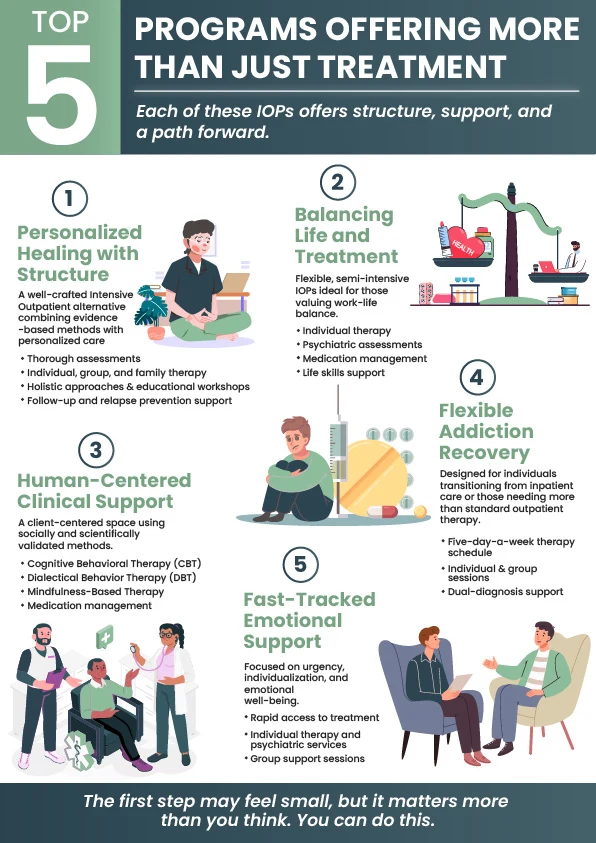
IOP is for when you’re still holding things together, but the energy it takes to hold them is unsustainable. You are functional by most external measures. But you know that functional and okay are not the same thing. You’ve known that for a while. The very fatigue of keeping the performance going is exhausting in itself, and you have something down at the bottom of it all that has been getting worse, not better, and that you are sick of faking.
Most people significantly underestimate their level of need. Not out of dishonesty but out of the same coping mechanism that kept them functioning this long. If you’re genuinely not sure which level describes you, sit with that uncertainty for a moment. Uncertainty about whether you need more support is almost always a signal that you need more support.
Where You Are in the Journey
PHP and IOP are not competing products. They’re rungs on the same ladder, and most people who spend time in the mental health system will touch both at some point.
PHP often functions as a bridge from inpatient hospitalization back to daily life for people who’ve been discharged but aren’t ready for the relative independence of IOP. Or it functions as a firewall. Intensive enough to stabilize someone who’s heading toward inpatient if nothing changes. It catches people on the way up and on the way down.
IOP is often where people start when they’ve recognized the problem clearly but aren’t yet in crisis. It’s also where people land after stepping down from PHP, when the acute phase has passed and the real long-term work begins. Think of it less as a lesser version of PHP and more as a different phase of the same journey.
You’re not picking the better program. You’re picking the right next rung.
The Practical Truth About This Decision
You should not be making this decision alone, based on a website article.
A good clinical intake assessment is specifically designed to answer this question. A clinician who knows what they’re doing will ask about your current level of functioning, your symptoms, history, your home environment, your previous treatment, and your practical constraints. They will put all of that together and give you a real recommendation, not a sales pitch for whichever program has availability.
Final Thoughts
Theseus came out of the Labyrinth because he had the thread, and he listened to it. He did not override it, as there was a better corridor, which appeared to be attractive. He did not rethink it halfway along the road because the road got narrow. Even after he could no longer see the direction he was taking, he followed it.
You have already discovered the thread. You are asking the right questions. The second thing would be a real discussion with a person who is able to look at your unique circumstance and give you a straightforward answer on which direction to take.
At Clover Behavioral Health, that conversation is where everything starts. Not an enrollment form but a conversation. If you’re somewhere in Salem weighing this decision and it feels heavier than it should, reach out. We’ll help you find the right program!