
The Quiet Signs of Trauma Most People Don’t Recognize
You are sitting in a meeting.
Someone is talking. Something about deadlines, something that requires your attention and probably your opinion at some point. You are nodding at the right intervals. Your coffee has gone cold. The fluorescent light above you has a faint flicker that nobody else seems to notice.
And somewhere underneath all of it, something is pulling.
Not loudly. Not in a way that would show on your face or interrupt the meeting or give anyone in the room a reason to ask if you’re okay. Just a quiet, persistent undertow. A feeling of being slightly elsewhere. Present in the room, absent from yourself. Watching the meeting happen from a small, imperceptible distance, the way you watch most things happen, wondering when exactly you started feeling like a guest in your own ordinary life.
This is what unprocessed trauma feels like. Not a crisis. Not a breakdown. Just a permanent low hum underneath everything, making presence feel like performance.
The Mental Health Effects of Trauma
Trauma does not stay in the past. This is the first and most important thing to understand about it and the most counterintuitive, because the whole strategy most people use to survive it is to leave it there.
The brain doesn’t experience time the way a calendar does. A traumatic memory that is not processed appropriately remains biologically alive. Stimulating identical stress responses, exciting identical neurological pathways, and dragging the nervous system into the same state of threat in which the initial event took place. The past becomes permanently present as a physiological fact that your body keeps returning to without your permission.
The effects spread across every system. Depression is when things that should be important start to lose their color. Anxiety that reads as being high-strung or intense rather than as the hypervigilance of a nervous system that never got the signal that the danger passed. Emotional numbness that kept you functional during the trauma and now keeps you slightly removed from your own life.
Physically: interrupted sleep, a startled body, and a clenched jaw, which has been clenched long enough that you no longer notice. The specialized fatigue of a nervous system always alerted to danger. Scanning for threats in rooms where there aren’t any, burning resources on protection you no longer need.
The cruelty of trauma is not only what it does to the hard moments. It’s what it steals from the ordinary ones.
Trauma-Related Disorders
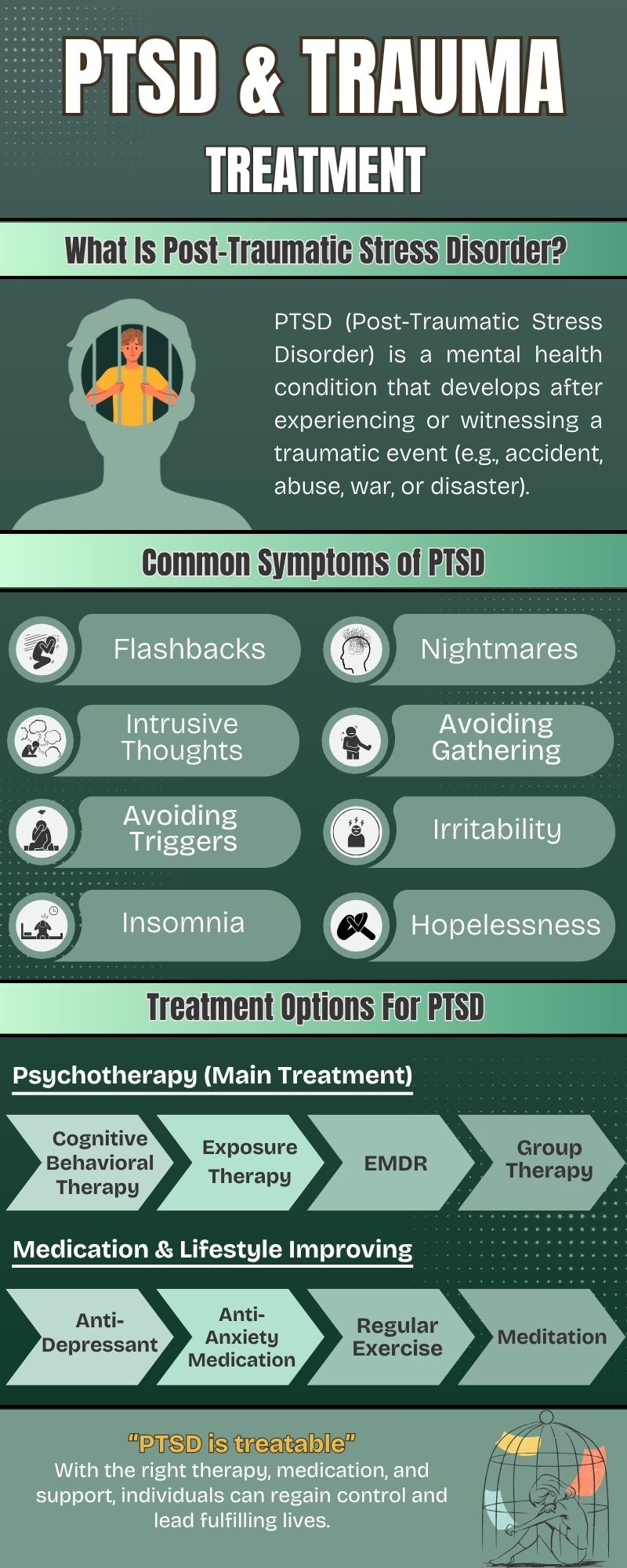
PTSD is the label that most individuals identify with trauma, and the label is true, serious, and more prevalent than the majority might think. Nevertheless, it is not the entire landscape.
Acute Stress Disorder manifests itself immediately after a traumatic incident. It is disorienting and intense and can be confused with a breakdown instead of a clinical reaction to an overwhelming experience.
Complex PTSD or C-PTSD is caused by extended or multiple exposure to trauma that is not an incident but rather a persistent condition of threat, manipulation, or offense. Child abuse, domestic violence, and years in a system that led to harm. C-PTSD carries all the features of PTSD alongside profound difficulties with self-perception, relationships, and emotional regulation that standard trauma treatment doesn’t always address adequately.
Trauma-related disorders exist on a spectrum. All of them deserve serious, structured treatment. Not only the ones that meet the formal threshold.
Core Components of Trauma-Focused Intensive Outpatient Programs
A trauma-focused IOP is not a place to describe what happened while someone listens. It is structured clinical work, specific to how trauma operates, built in a sequence that matters.
It begins with safety and stabilization. Before any processing happens, the program builds the container with grounding skills, distress tolerance, and the internal and relational safety required for trauma work to be tolerable rather than retraumatizing. This step cannot be skipped. Opening a traumatic memory without sufficient stabilization doesn’t heal it. It just reactivates it.
From there, the evidence-based modalities do specific work. EMDR is an 8-phase psychotherapy that operates on a neurological basis, enabling the brain to reprocess traumatic memories. using bilateral stimulation. Studies suggest that three 90-minute sessions prove very effective for single-trauma victims, as they no longer meet criteria for PTSD.
Cognitive Processing Therapy addresses what trauma does to beliefs. The conclusions are written in permanent ink. 12 weekly, 60-120 minute sessions focus on identifying reasons behind the trauma and irrational thoughts that hinder recovery. Beliefs like “I am beyond damage” are challenged under the therapist’s supervision and replaced with logical statements.
Somatic approaches recognize what talk therapy alone cannot always reach. That trauma lives in the body as much as the mind. The clenched jaw. The shallow breath. The startle response. Body-based work addresses the physiological dimension of trauma directly, teaching the nervous system, not just the mind, that the threat has passed.
Trauma-informed group therapy offers something individual work cannot replicate. The experience of being seen by people who understand without explanation. Who have their own weight and recognize yours. That witnessing, quietly and consistently, begins to repair the isolation that trauma almost always creates.
Woven through all of it: psychoeducation. Finally, understanding why your brain does what it does. Why the undertow happens. Why ordinary Tuesdays feel unreachable. Knowledge doesn’t heal trauma, but it dismantles the shame that so often surrounds it.
Benefits of Intensive Outpatient Programs for Trauma Recovery
The case for IOP over standard weekly therapy in trauma treatment comes down to one clinical reality: avoidance is the engine of PTSD, and weekly sessions give avoidance too much room to operate. The work opens something in a session. The week passes. The nervous system closes it again. Progress gets made and then quietly undone, in a cycle that can last years.
IOP’s frequency creates momentum. The work builds on itself session to session without enough gap for avoidance to fully reassert. The stabilization holds. The processing has continuity. Skills get practiced often enough to become reflex rather than theory.
You stay in your life while this happens. Home, employment, relations, and day-to-day duties go on. This implies that the skills you develop are put to the test in real time, in the real situation in which you are required, as opposed to a clinical scenario that has no resemblance to a Tuesday afternoon conference.
Co-occurring struggles are handled together because that is how they exist. Not sequentially, not in separate programs, but together, in a treatment structure that understands they are related.
And when the intensive phase ends, the support doesn’t simply stop. A step-down structure from IOP to standard outpatient to whatever ongoing care fits your life means the ground you’ve built doesn’t disappear the moment the program does.
Final Thoughts
At Clover Behavioral Health in Salem, NH, that work is what we do. If you’ve been living with the undertow long enough, we’d like to talk. Not about what’s wrong with you. About what happened to you and what it’s going to take to finally let it be the past.
Reach out to us today. You can call us directly, fill out our contact form online, or simply stop by. You’ve been managing the undertow long enough. You don’t have to keep treading water alone.