
Why Structured Mental Health Programs Work Better Than Weekly Therapy
Imagine trying to learn a new language by reading one page a week: you’ll learn it, but it’ll take a long time. In contrast, if you practice that same language for a few hours each day, you’ll get fluent in it much faster. Interestingly, the same rule applies when you’re trying to fix your mental health and get over conditions like anxiety, depression, or PTSD.
If you enter a structured mental health program, therapy and healing work become part of your routine. And as we all know, routine builds better health (both physical and mental) and improves your lifestyle.
However, a structured mental health treatment plan means more than sticking to a routine. These treatments provide you with more impactful therapies and medications to bring your mental well-being back on track faster.
This article explains how weekly therapy, despite being incredible, is not as powerful as a structured mental health program. Keep reading.
What Makes Structured Mental Health Programs Better Than Weekly?
Your brain can reach a tipping point where it needs intensive support to control and reverse the damage. Luckily, most well-planned mental health programs provide the hand-holding you need to come out of difficult situations.
That said, here are the reasons that make structured mental health programs a superior choice:
More Focus on Results Than Venting
Weekly therapy sessions are incredible because you get to share your burden and get advice on managing yourself better. However, when the situation is extreme (for example, if you have Major Depressive Disorder), these weekly sessions prove to be more of a venting than healing.
In a normal therapy session, you would spend 50 minutes recounting how your week went, and the therapist would guide you on how to be better in the coming week.
But when that session is over, you return to your life without a concrete shift in the symptoms, and therapy feels like a temporary relief.
Therefore, structured mental health programs move past the discussion phase and work on a result-oriented framework. For instance, if you start a day treatment (also called partial hospitalization), your treatment sessions will all have specific clinical objectives. You might learn behavioral tools under expert supervision to retrain your brain’s response to stress.
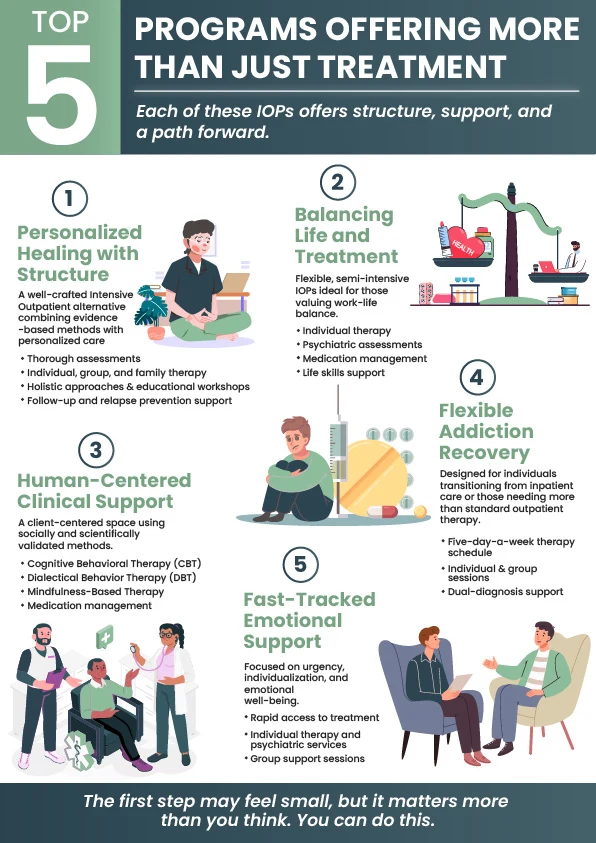
Put simply, this approach prioritizes overcoming your symptoms and improving functional recovery over conversation. And since you also track your progress through objective milestones, you essentially work with measurable results.
Resetting the Environment
Healing your mental health is difficult when your environment doesn’t change for the better. For example, if your brain is often on high alert in your daily life because of the stressors around you, you need a change of environment to overcome your challenges. But since weekly therapy asks you to do the hard work of healing for one hour, you have to deal with the same environment on the regular.
On the other hand, a structured mental health program can provide a necessary physical and mental break. For instance, if you move into a credible mental health treatment center, you remove the external noise of work, toxic relationships, and responsibilities.
Needless to say, that change feels like a strategic reset because in that protected space, your nervous system can drop out of a fight or flight response. Slowly, the physiological shift makes your brain more receptive to treatment because, away from the daily problems, you can dedicate 100% of your energy to recovery. But do know that this change of environment and place comes at a price and demands time commitment.
Targeting Biology
Mental health is as much a biological issue as it is an emotional one. Let’s understand that with an example. Suppose you struggle with severe depression or PTSD, which will mean your brain chemistry and hormonal levels are often out of balance.
If you stay loyal to your weekly therapy, it cannot always address the physical reality of a nervous system that’s breaking down. Therefore, structured mental health programs approach your physical and mental health with medical precision.
In a clinical setting (whether for a few hours each day or the whole day at a center), doctors regularly monitor your vital signs and chemical responses to align your physical and mental health. If a certain medicine prescribed for your depression is showing side effects, the team can immediately adjust it.
Dual Diagnosis Integration
By definition, a dual diagnosis means that a person has a mental health disorder along with being addicted to drugs or alcohol. Both these conditions are deeply linked, and one often triggers or worsens the other.
If you only take therapy, it means you’re only working on your mental health, and there is a gap that must be filled for your complete health. And that’s when structured mental health programs take the lead.
These treatments work via total integration as you work with one clinical team that treats both conditions. Since you cannot reach long-term stability if half of the equation is ignored, the approach is incredibly helpful.
During your treatment, medical experts and therapists will collaborate to adjust your plan to prevent relapse and fix your mental health challenges.
Rebuilding Daily Rhythm
When you’re fighting with depression or anxiety, your brain can lose its ability to self-regulate. As a result, your sleep, socialization, and even eating habits suffer. Slowly, these disruptions to your circadian rhythm keep your stress hormones elevated.
And since weekly therapy cannot enforce the physical consistency required to reset your biological clock, you need a structured program. This program will bring you a schedule to help regulate your nutrition, motivate you to get sunlight exposure, and work on your sleep.
These changes will fix your cortisol and melatonin levels to prevent the lethargy that feeds depressive episodes. The mandatory repetition of a structured program helps bypass the struggle of willpower and makes these new habits the default settings for your body and mind.
Consistency Helps in All Fields of Life
If your mental health is not at its best, start treatment right away and be consistent with the efforts. You’ll soon realize that no matter how big your challenges feel, your willpower and dedication can break them. And in your journey to a brighter tomorrow, Clover Behavioral Health is always a call away.