
Why 2:47 AM Is When Anxiety Gets the Loudest
The clock on the wall says 2:47 AM.
You know this because you’ve been watching it. Not because you want to, but because your brain has decided that 2:47 AM is an excellent time to revisit every unresolved thing in your life simultaneously. The conversation from three days ago that could have gone differently. The email you sent that might have landed wrong. The larger, vaguer fears that don’t have names, just weight.
You know, intellectually, that none of this is useful. You know that lying here running scenarios is solving nothing. You know all of this clearly, and it makes no difference at all, because the part of your brain that knows things and the part running the late-night threat assessment are not on speaking terms.
What Anxiety Is And What It Isn’t
Anxiety is not worry. This distinction matters more than it sounds.
Worry is a thought process. Something that follows a logic, something that can be interrupted with the right insight. Anxiety is a physiological state. A nervous system stuck in threat-detection mode, running a biological alarm that was designed to protect you from predators and has been misdirected toward inbox notifications, social situations, and sourceless dread that arrives at 3 AM for no articulable reason.
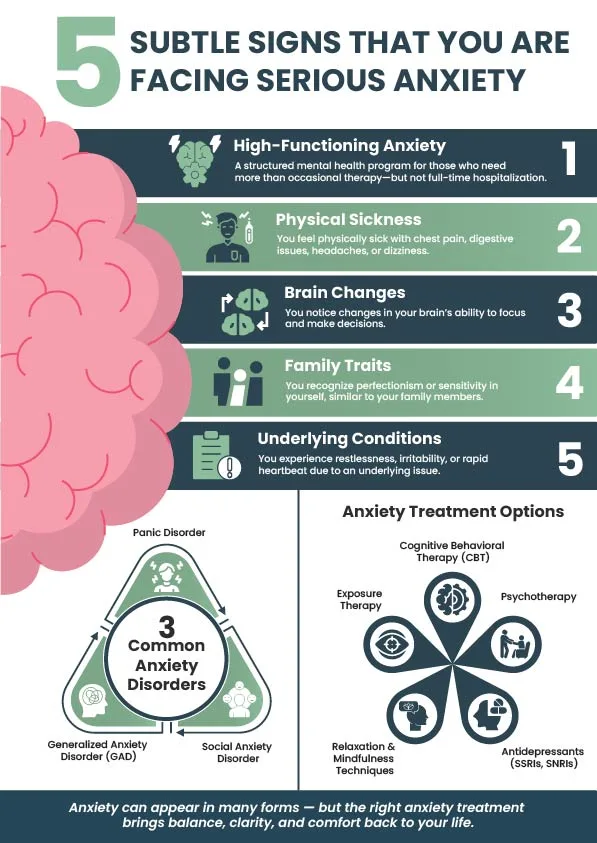
An anxiety disorder is not an intense version of normal worry. It is a misfiring alarm system. One that won’t shut off even in rooms that are completely safe. This keeps the body in a state of low-grade emergency long after any emergency has passed. It shows up as Generalized Anxiety Disorder. The pervasive dread that colors everything. As a panic disorder, it is the sudden physical conviction that something catastrophic is happening. As social anxiety, which is the exhaustion from being among people when your brain treats every interaction as a performance review.
Different presentations, same fundamental misfiring. The alarm is on. It has been on for a long time.
The Performing-Calm Tax
What is rarely mentioned in clinical descriptions of anxiety is the cost of appearing normal.
Most high-functioning anxious people are not visibly anxious.
They are composed, prepared, and reliable. Often the person other people describe as having it together.
This is not an accident. It is the result of an enormous, continuous, mostly invisible effort. The rehearsed responses. The careful management of every social variable. The hypervigilance disguised as attentiveness, the control disguised as competence.
Running this performance has a price. A slow, compounding tax on energy, presence, and joy. You get through the day, handle what needs handling, and arrive home with nothing left. Not because the day was hard, but because you spent it managing an internal alarm nobody else could hear. Plans get cancelled. New situations get avoided. The world gets slightly smaller over time. Maybe not all at once, just gradually, by degrees, in ways that are easy to rationalize and difficult to reverse.
Features Of Anxiety-Specific IOP In Salem, NH
The clinical work in an anxiety-focused IOP is built around one central truth: you cannot think your way out of a physiological state. Insight is necessary but insufficient. The nervous system needs to learn. And learning requires repetition, practice, and enough sustained contact with what you fear that the brain eventually registers it as safe.
Cognitive Behavioral Therapy forms the backbone of identifying the thought-feeling-behavior loop that anxiety runs on and interrupting it before it completes. Exposure and Response Prevention is the counterintuitive heart of anxiety treatment: moving toward what you fear, in graduated and supported steps, teaches the nervous system what no amount of reassurance can. That the alarm was wrong, that the room is safe.
Dialectical Behavior Therapy, on the other hand, contributes to distress tolerance for moments when anxiety spikes beyond the reach of thought. Acceptance and Commitment Therapy shifts the goal by not eliminating anxiety but changing your relationship to it, learning to hold the feeling without being governed by it.
Lastly, the group component, which surprises people more than almost anything else. Anxiety is profoundly isolating, partly because of the avoidance it generates, and the performance of calm makes it invisible to everyone around you. Sitting with people who understand the 2 AM clock-watching, the catastrophizing, and the exhaustion of a brain that will not quiet? That witnessing dismantles something.
Moreover, the shame that has been running alongside the anxiety for as long as you can remember? Group therapy reminds you that you are not uniquely broken. Rather, you are a person with a misfiring alarm, surrounded by others with the same one, all of you learning to turn down the volume.
What Life Looks Like on the Other Side
Not cured. That is not the promise, and anyone making it is selling something.
What changes is quieter and more real. The alarm still exists, as it was built into your nervous system, and it will always be part of how your brain works. What changes are the volume, the frequency, and your relationship to it when it fires.
2:47 AM becomes, more often than not, just a time on a clock. The situations you’d been quietly avoiding? You start entering them again, not because the anxiety disappears but because you’ve learned you can carry it into the room and still be okay on the other side. The world gets larger. You become more present in the ordinary moments that anxiety used to pull you out of. You can finally live a life that expands back toward the size it was always supposed to be.
One Last Thing Before You Make A Final Decision
Somewhere in New Hampshire, it is midnight, and someone is watching a clock. If that’s you, if the narrowing, the performing-calm tax, and the Tuesday nights feel familiar, we’d like to talk.
At Clover Behavioral Health, our anxiety treatment IOP is built for people who have been managing the alarm on their own for long enough. Reach out today by phone, contact form, or simply stopping in. The first conversation is just that: a conversation. No pressure, no commitment, and no paperwork before you’re ready.
The alarm has been on long enough. You don’t have to keep listening to it alone.