
From Morning Groups to Afternoon Skills: Inside a Day Treatment Program, Chelmsford
It’s 8:30 AM on a Tuesday, and you’re sitting in your car outside the treatment center. Again. You’ve been doing this dance for weeks now. Showing up, sitting in the parking lot, sometimes leaving without going in. Today feels different, though. Today, the thought of going home to an empty space and spending another day fighting your own mind feels worse than whatever’s waiting inside those doors.
Day treatment isn’t what most people picture when they think about getting help. It’s not the 30-day residential program you see in movies. It’s not the once-a-week therapy session that feels like a drop in the ocean. It’s something in between. Intensive enough to create real change, flexible enough to let you keep one foot in your regular life.
In Chelmsford, day treatment programs are becoming the bridge that connects people to recovery without completely uprooting their world. But what actually happens during those six hours? What’s it really like to show up, day after day, to work on the hardest parts of yourself?
Let’s walk through what a typical day looks like.
Morning Check-In—Taking Your Emotional Temperature
You finally walk through those doors fifteen minutes late. You’re not the only one who needed extra time in the parking lot. The morning check-in circle has about eight chairs today. Different ages, different stories, same underlying current, since everyone’s trying to figure out how to live without the thing that was slowly killing them.
The room is comfortable but not fancy. Low lights, chairs so as to make a circle, perhaps some flora in the corner. It is more of a living room than a medical facility. That’s intentional.
How do you feel today on a scale of one to ten? It is a very basic question, yet to someone who spent years desensitizing themselves to all feelings, it feels like asking them to speak a foreign language.
You might share about the fight you had last night. How you usually would have drunk about it, but instead used that breathing technique from last week. Still angry, but you’re here. That’s the thing about day treatment: it meets you exactly where you are.
Angry? Sad? Completely numb? All of it gets space here. No one expects you to show up healed. They expect you to show up.
Group Therapy—Where Secrets Stop Being Weapons
The real work begins. Today’s group therapy is about shame. That toxic voice that says you’re broken. That you’re unworthy of love and will ruin everything you touch.
The facilitator doesn’t begin with theories or worksheets. Instead, they ask a question: “What would you say to your best friend if they told you the things you tell yourself?”
The room goes quiet. The silence lingers. You think about your inner monologue from this morning alone: “You’re pathetic.” Normal people don’t need this much help. You’re going to fail at this too.
Someone across the circle admits they’d tell their friend they’re being way too hard on themselves. That everyone struggles sometimes. The facilitator asks the obvious follow-up: “So why don’t we deserve that same kindness?”
This is where day treatment gets its power, not from having the right answers, but from sitting with the hard questions in a room full of people who understand. Your addiction isn’t the most shocking thing anyone’s heard. Your darkest thoughts aren’t unique. That shame that feels so isolating? Everyone here knows its weight.
Break Time—The Power of Normal Moments
Coffee break sounds trivial, but it’s not. These fifteen minutes teach you to exist in social spaces without substances or anxiety taking over. How to make small talk about the weather when your brain wants to catastrophize everything.
The coffee is actually decent. People cluster in small groups or sit quietly. Some step outside for fresh air. You’re learning that recovery includes these mundane moments. That healing happens in the ordinary spaces between the intense work.
Educational Sessions—Understanding Your Brain
Back in the main room, but the energy shifts. This isn’t group processing; this is learning about the science behind what you’re experiencing.
Today’s topic: how trauma changes your brain, and why your reactions might make perfect sense given what you’ve been through.
You learn about the amygdala, your brain’s alarm system that got stuck in the “on” position. About neural pathways carved deep by repeated patterns.
About why willpower alone never worked because you weren’t fighting a character flaw. You were fighting biology.
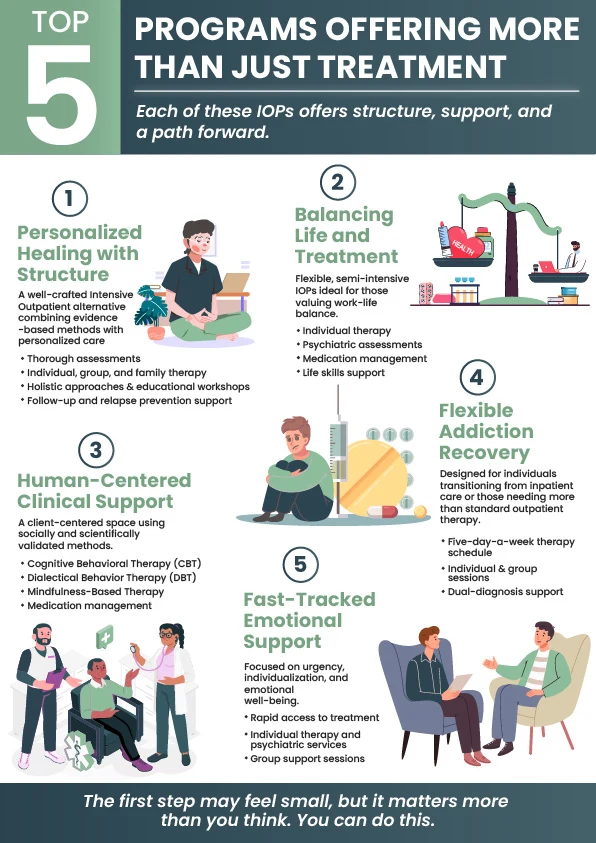
These sessions give you language for your experience. Suddenly, that constant sense of danger has a name. That inability to regulate emotions makes sense. You’re not broken; your nervous system is trying to protect you the only way it knows how.
Skills Training—Building Your Emotional Toolkit
The afternoon shifts to hands-on learning. Today it’s Distress Tolerance. A fancy term for “how to not lose your nerves when life gets overwhelming.”
The room setup changes. Chairs in a circle become workstations. Notebooks come out. This isn’t group therapy anymore; it’s practical education for people whose emotional education got interrupted somewhere along the way.
You practice the TIPP technique – Temperature, Intense exercise, Paced breathing, Progressive muscle relaxation. It sounds clinical, but when you’re in full panic mode at 2 AM and your old coping mechanisms aren’t an option, these aren’t just concepts. They’re lifelines.
You learn that holding ice cubes can interrupt a panic attack by shocking your nervous system back to the present. That doing push-ups until your muscles burn gives anger somewhere to go besides your mouth. Simple tools, but they work.
The Environment That Makes It Work
At Clover Behavioral Health Center in Chelmsford, day treatment isn’t just a schedule of activities. It’s a carefully designed ecosystem where healing happens in community. The space doesn’t feel like a medical facility at all. It feels more like a comfortable office. There’s natural light. Cozy seating. Areas for group work, and quiet corners for reflection.
The staff flows easily between roles. A facilitator in the morning. An educator at lunch. A counselor in the afternoon. They know your story. They know your triggers. They know your goals.
Ready to show up for yourself? Day treatment at Clover Behavioral Health Center might be the intensive, flexible support you’ve been looking for. Call us today and take the first step toward building the life skills you deserve.