
How DBT Therapy Program in Westford, MA, Helps You Stay Grounded Through Emotional Ups and Downs
Research has repeatedly shown that over 70% of individuals experiencing emotional distress never seek professional help, often because they believe they should “figure it out” on their own. Maybe, this overestimation is our downfall.
Take the situation of Westford, MA, for instance. Over 1.2 million people across Middlesex County struggle with anxiety, depression, or chronic stress – so much so that in the 2022 Greater Lowell Community Health Needs Assessment, participants actually ranked mental health as one of the top three health needs of their town.
The good news is that local authorities paid attention. Westford now observes an official Mental Health Awareness Month, complete with community education and outreach.
The bad news? Many of the residents still hesitate to reach out, not only because of stigma, but because of self-blame and the very belief that their own pain isn’t serious enough.
We need to stop gaslighting ourselves, you know.
Today, we will help you understand what’s the reason behind the way you feel, and how you can get help from DBT Therapy Program in Westford, MA, to overcome this.
Let’s get started:
The Subtle Weight of Everyday Emotions
The human brain has evolved over time to prioritize survival over sensitivity, which simply means we react faster to negative emotions than to joy. When this emotional distress builds up, the amygdala (the brain’s emotional alarm system) becomes hyperactive, while the prefrontal cortex (which governs logic and decision-making) becomes less active. As a result, we are physically unable to think clearly or regulate emotions effectively, and emotional recovery takes longer than expected.
When we talk about the weight of emotions, it is different for everyone because studies show that around 60–70% of individuals feel emotionally triggered in situations involving perceived rejection or loss, while others react more strongly to uncertainty or loss of control. This highlights the uniqueness of human emotion; we may live through the same event, but we rarely feel it the same way.
So, for instance, if a close friend cancels plans, you might feel disappointment and move on, while I might feel abandoned or unimportant. This is because our emotional memories and neural pathways are shaped by different life experiences and attachment patterns. But scientifically, your brain might register the event as a minor social inconvenience, while my brain might activate a stress response similar to a real threat.
Hence, some individuals feel the same situation heavier on their shoulders while others don’t – not because one is weaker, but because our brains and emotional wiring process the world through deeply personal filters.
When Feeling Deeply Becomes Draining
Before we explain this situation, please note that over 53.8 million individuals in the U.S alone struggle with depression, anxiety, or both, on a constant basis.
Here’s what happens:
1. External/ Internal Trigger:
Some event occurs which resonates with a past experience of an individual. The event itself may be ordinary, but it can trigger the memory of a past trauma that was not so ordinary. This results in emotional flooding that causes the body to react as if it were a past incident occurring all over again.
2. Meaning-Making:
Our brain quickly turns to survival mode and assigns a meaning to this event’s happening – usually a negative meaning. This is because our brain is trying to protect us from danger or emotional pain, even when the current situation may not even be threatening.
3. Emotional Activation:
As a result of this micro-intervention, we feel the emotions rising, which are both intense and immediate.
4. Physiological Response:
At the same time, our body reacts to the situation by going into attack mode.
5. Cognitive Narrowing:
This is the most exhausting part: our brain starts replaying the past trauma, catastrophizing it further, and causing more memory hurt.
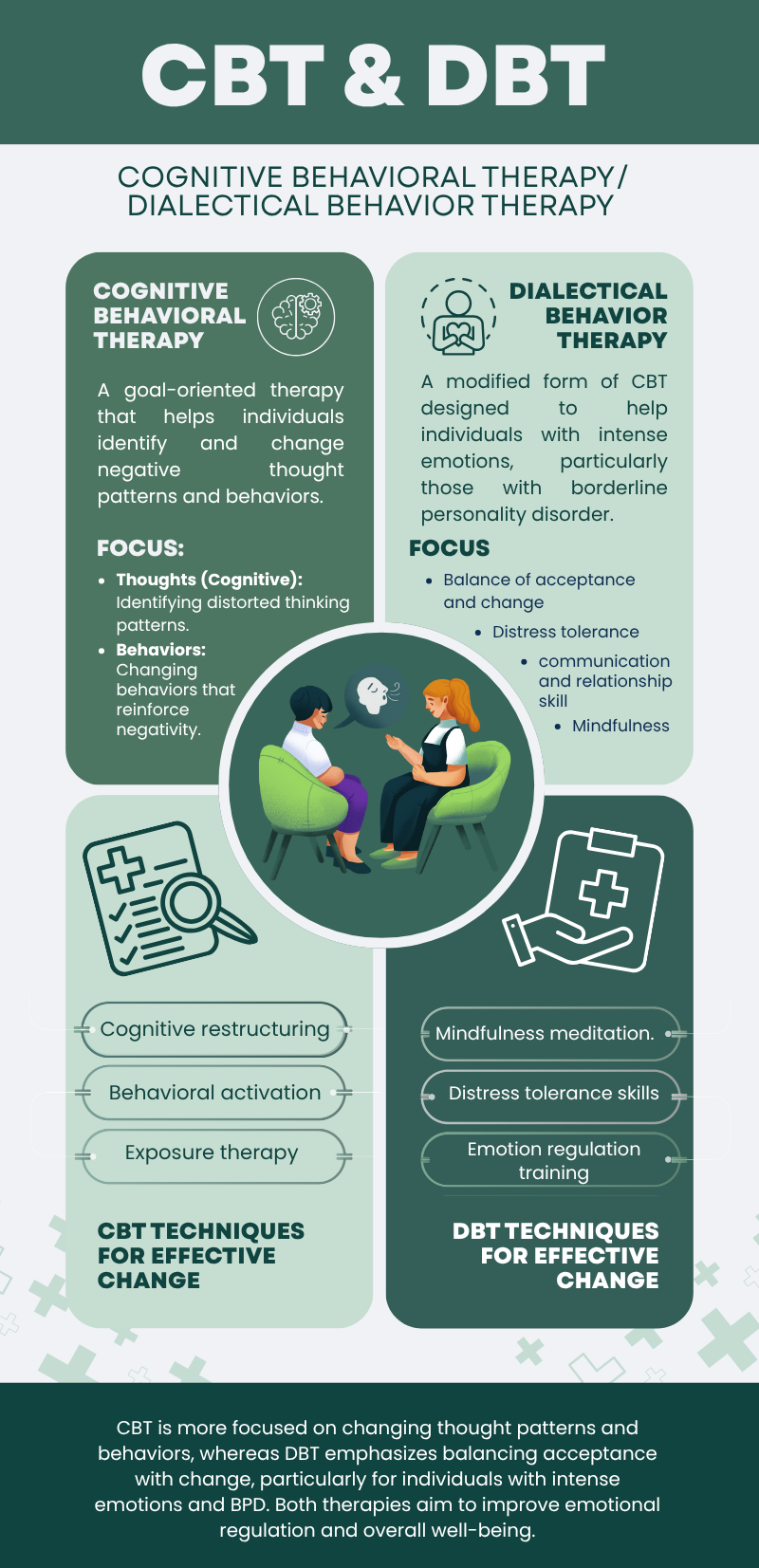
Now, in this entire situation, most of us tend to move towards short-term fixes such as using quick relief behaviors (texting/scrolling) to divert our minds. The problem with short-term fixes is that they help you calm down in the moment, but the pain stays, and the next time an ordinary event occurs, your body goes through the exact same trauma again.
Therefore, the best option is to look for a long-term strategy that can gain emotional stability and resilience. Thankfully, there is a solution: DBT Therapy Program in Westford MA.
How DBT Therapy Program in Westford MA Helps You
The problem with us, the human race, is that we overestimate our strength. Be it emotional pain or past trauma, loneliness or burnout, we think we are so strong and independent that we can handle it all alone. That’s not true. Humans are social animals, and we need connection to heal, perspective to grow, and support to stay steady.
Let’s talk about how DBT Therapy Program in Westford MA can help you:
1. Emotional Regulation Skills:
First and foremost, DBT Therapy Program in Westford MA teaches you how to identify, label, and manage intense emotions before they get out of your control. With DBT programs, you get access to practical exercises that can help you shift your brain to clarity in moments of emotional distress
2. Mindfulness Practice:
DBT is all about mindfulness, and therefore, these programs teach you grounding techniques in order to anchor yourself during emotional surges.
3. Distress Tolerance Techniques:
A DBT Therapy Program in Westford MA, also focuses on helping you build resilience to actually face the painful moment instead of looking for short-term fixes or distractions.
4. Coaching Support:
DBT isn’t just talk therapy; it also includes coaching and group sessions that help you apply these learned skills to real-life situations.
DBT Therapy Program in Westford MA: Your Next Step Towards Emotional Balance
You may think you are too strong and you don’t need any help or guidance from anyone. Well, this isn’t about weakness either. But if you try to override the natural emotional processes of your brain, it eventually pushes back, which can result in burnout, anxiety, or emotional shutdown.
Many are struggling already, but this needs to change. We need to bring up conversations around emotional health so that seeking support feels normal, and healing feels possible.
Clover Behavioral Health is trying to raise awareness for the same. We aim to support you with compassion, structure, and evidence-based care, so that you can regain balance and feel in control again.
Please don’t hesitate to take the first step. Know that we are here, and we truly want to be the safe space you’ve been needing. So pick up the phone and dial 978-216-7765, and leave the rest to us.
Because we assure you, you deserve peace, and you don’t deserve to go through the chaos alone.