

Is IOP for Mental Health in Andover, MA, Just For Crisis?
When you’re not in a full-blown crisis, but are absolutely not okay, it’s a different kind of struggle. Most people in this situation minimize their struggle and try to get through it without help.
That little voice of denial is why nearly 67% of US adults report feeling like their problems aren’t bad enough to seek help. It eventually means they don’t take their pain seriously until it renders them unable to function normally.
But we don’t want that to happen to you. Even if you’re okay mostly (we love that for you) and face that phase occasionally, it can be a sign to get stronger support.
That’s why this blog discusses the signs to give yourself more support in the form of IOP for mental health in Andover, MA. Keep reading to know when to make this decision!
The Common Misconception about IOP for Mental Health in Andover, MA
We often compare our pain to others and try to find solace in ‘others have it worse’ or ‘my problem is not that big.’ It slowly erodes your strength and results in frequent setbacks, slowly pushing you into a crisis mode. Therefore, knowing when to step up your care and get IOP for mental health in Andover, MA, is crucial.
Most take IOP for mental health like a trip to the ER or being released from a hospital stay. The word ‘intensive’ can be partly blamed for it because it makes us hold off. We assume we aren’t “sick enough,” and that waiting game makes recovery much harder.
Let’s flip that idea because IOP for mental health in Andover, MA, is a proactive powerhouse. It works as a rehabilitation for your brain and helps stop the cycle of setbacks. It gives you the structure and professional support to build strength and stabilize your life before your mood or anxiety completely takes over.
The Subtle Signs It’s Time to Level Up and See IOP for Mental Health in Andover, MA
Now comes the big question: how to know if you need IOP for mental health in Andover, MA? If occasional therapy isn’t enough, here are some non-crisis indicators, which, if they exist, make IOP the solution:
Coping Fatigue
Coping fatigue is the sheer exhaustion and depletion you feel when your mental health condition demands near-constant effort to maintain basic function.
For instance, if your healthy mind takes 10 units of energy to handle a stressful day, it may take 50 units when you’re not doing well mentally.
Since it comes from the maintenance required for you to function well, it means the treatment is not working, and IOP for mental health in Andover, MA, can solve that.
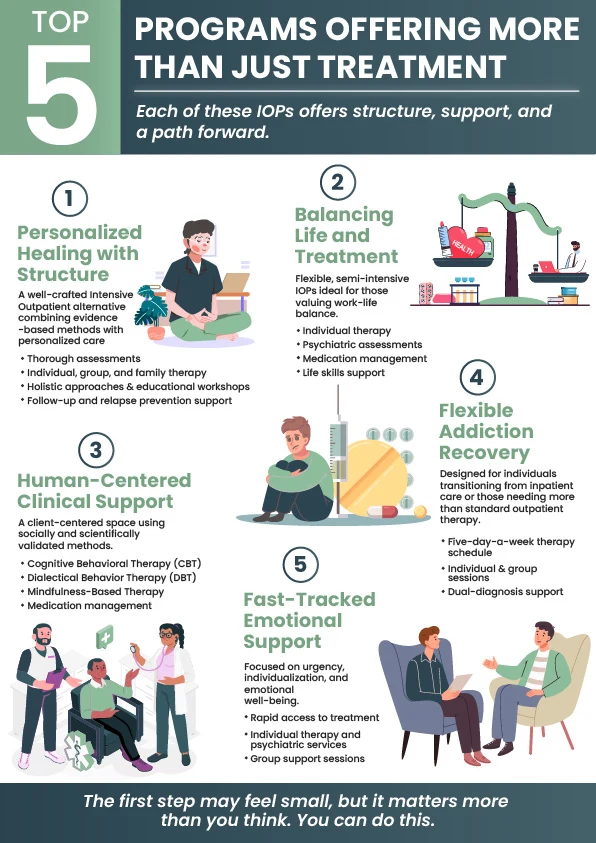
Intensive outpatient treatment provides you with the concentrated skill-building required to establish muscle memory for emotional regulation. Increasing treatment density also reduces the cognitive load needed to manage your symptoms. And slowly, you shift from constantly struggling to stabilizing.
Stalled Progress
If you take therapy to talk through your problems, but things get back to being the same in routine life, your progress is stalled. Now we need a stronger plan, like IOP for mental health in Andover, MA, to solve the problem from all sides.
IOP directly addresses this plateau through structured, repetitive practice. You engage in therapy (like CBT or DBT) 3-5 days a week and move new skills from conceptual knowledge to automatic behavior. The program’s density forces you to immediately apply techniques to rewire established negative thought patterns.
Naturally, when you spend several hours multiple days a week working through a problem, it starts losing its grip. And since emotion regulation is also part of IOP sessions, you perform better in triggering situations.
Increased Isolation
When things are tough, the easiest thing to do is pull away. That’s why people struggling with mental health start cancelling plans and dread going to work or school. This increased isolation is a sign that the effort required to interact with the world has become overwhelming. Although most people assume that isolation protects them, it only makes problems worse by feeding anxiety and depression.
Therefore, IOP naturally breaks the isolation cycle because it requires you to attend structured sessions multiple times a week. This rhythm gives you a safe space to practice social skills and gently reintegrate into a structured setting before you have to face the world.
The “Almost” Moments
The moments when you have thoughts of self-harm or intense despair are the most serious non-crisis indicators. Even if you step back from the edge at the last second, they are your mind’s genuine cry for help.
Think of it like this: If you’re constantly having to use your crisis plan or are frequently hovering near a breaking point, step up for your betterment.
These “almost” moments mean your current safety measures are paper-thin. That’s when IOP for mental health in Andover, MA, teaches you powerful crisis survival skills and helps you build a safety plan. And because you practice this plan quite often, it becomes your second nature. You learn immediate stabilization and know how to manage negative urges or self-harm thoughts.
Recurring Setbacks
Sometimes you have a couple of good weeks where your mood is stable, and you feel hopeful. Then something small happens, and you crash right back down. Put simply, your cycle of feeling well is followed by recurring setbacks. All of this shows that your recovery isn’t fully ingrained.
Luckily, IOP provides the necessary density of treatment to build solid coping skills. In it, you get to practice new ways of thinking and behaving long enough for them to become automatic habits (muscle memory for your brain).
Don’t Wait for Things to Become Harder
Mental health struggles take time to take root, and once those roots grow deep enough, pulling them out is harder. That’s why we, at Clover Behavioral Health, recommend people invest in a strong treatment plan.
If you’re unsure how severe your symptoms are or if IOP will work for you at this point, we hear you. Call us at 978-216-7765 and let’s plan your recovery in the best way possible.