

Mental Health Evaluations in Dracut, MA: What Happens When You Finally Stop Pretending
There’s a specific kind of exhaustion that comes from maintaining the performance. You show up to work. You respond to texts. You laugh at the right moments during dinner. And the entire time, there’s this background hum of wrongness you can’t name.
So you start searching. Mental health evaluation. Psychiatric assessment. Testing for depression or anxiety or whatever this feeling is. Then you stop. Thinking, what if they tell you something is wrong, and now you have to deal with that?
Let’s find out what a mental health evaluation actually is. Not the sanitized version from clinic websites. The real thing.
What a Mental Health Evaluation in Dracut Actually Looks Like
First fear people have: walking into a cold room with a clipboard-wielding professional who’s going to judge whether your suffering is legitimate enough.
That’s not what happens.
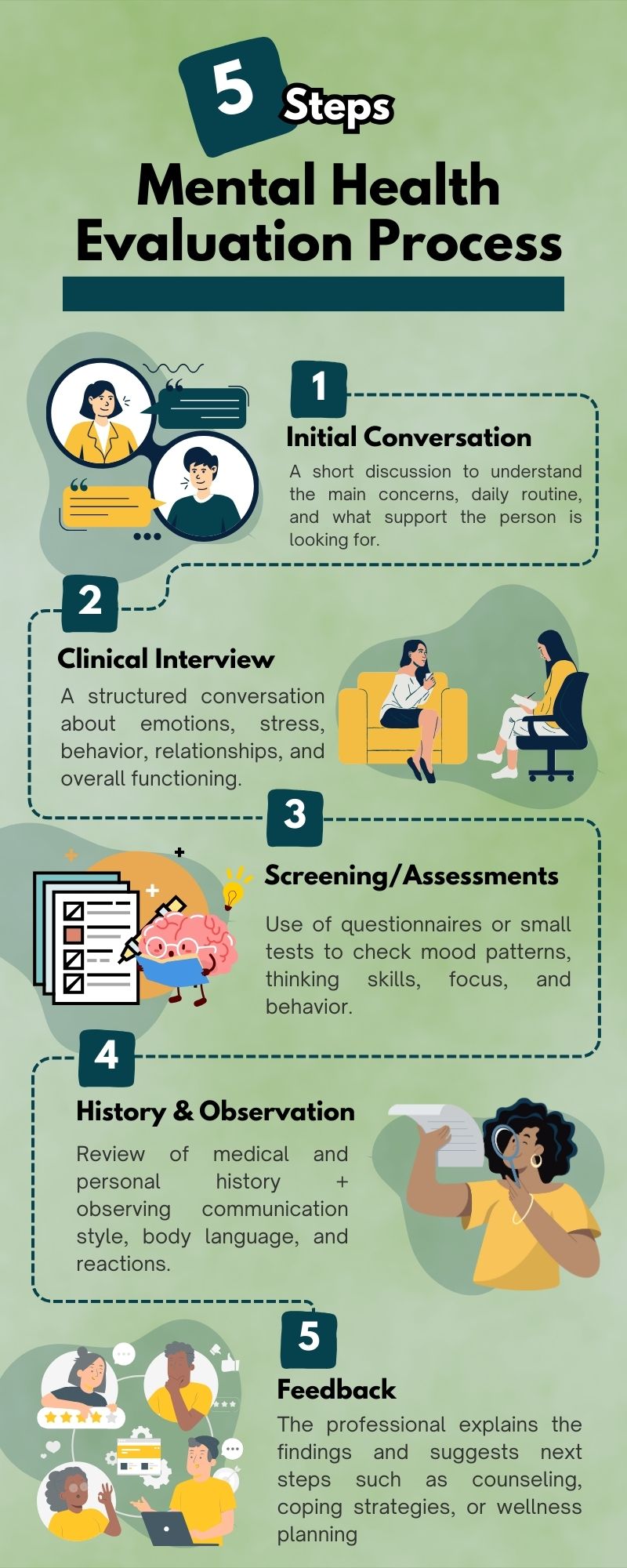
A mental health evaluation at Clover Behavioral Health in Dracut is a conversation with structure. We’re trying to understand the full picture of what you’re experiencing. Not to catch you in a lie. Not to minimize what you’re going through. To see it clearly so we can truly help.
The clinician asks about symptoms. Sleep patterns. Appetite changes. Energy levels. Concentration. Mood. But they’re also asking about your life. What changed six months ago? What does a bad day look like versus a really bad day? When was the last time you felt like yourself?
Evidence-Based Depression and Anxiety Screening Tools
We use standardized assessment tools. PHQ-9 for depression. GAD-7 for anxiety. Sometimes, the Beck Anxiety Inventory or the BDI-II if we need more detail.
These aren’t personality quizzes from the back of a magazine. They’re validated instruments that have been tested on millions of people. Each question corresponds to diagnostic criteria from the DSM-5. The questions are specific because vague doesn’t help anyone.
“Over the last two weeks, how often have you felt down, depressed, or hopeless?” Not sometimes. Not “it depends.” You pick: not at all, several days, more than half the days, or nearly every day.
That particularity is important, in that it provides us with a reference point. After three months of therapy we can retest again and objectively assess whether things are getting better. You may think that nothing has changed, but when your PHQ-9 dropped, something did change. Numbers don’t lie even when your brain does.
How Clinicians Determine Depression vs Anxiety vs Something Else
The evaluation isn’t just about confirming you have depression or anxiety. It’s about understanding what type, what severity, and what else might be happening.
Maybe you came in thinking you’re depressed, but the evaluation reveals your sleep is wrecked. You’re drinking more than you used to, and you haven’t felt safe in your own head for months. That’s not just depression. That changes the treatment approach entirely.
Or maybe you’re convinced you have ADHD because you can’t focus. However, during the evaluation, it becomes clear the concentration problems started right around the same time as the insomnia and the loss of interest in things you used to love. That’s not ADHD. That’s depression masquerading as something else, wearing a very convincing costume.
We’re also screening for things people don’t always mention. Trauma history. Substance use. Medical conditions that can mimic poor mental health symptoms. Thyroid problems feel a lot like depression. So does vitamin B12 deficiency. Your brain doesn’t care if the serotonin shortage is coming from major depression or from a thyroid that quit its job six months ago. The symptoms look identical.
A thorough evaluation rules those out or catches them early.
What to Expect During Your Psychiatric Evaluation
This is the part people dread. The clinician sits down and tells you what they found.
Some people get relieved. Finally, someone’s naming the thing. There’s a reason you feel this way, and it’s not because you’re broken or lazy or fundamentally flawed. Others get scared. The diagnosis feels too big. Too permanent. Like it’s going to define everything now.
Neither reaction is wrong. A diagnosis is just information. It’s a map of the territory you’ve been wandering through in the dark. It doesn’t change who you are. It explains what you’re dealing with so we can treat it effectively.
Lastly, here’s something important: diagnoses can change. What seems to be a major depression in an acute episode may later be identified to be bipolar or persistent depressive disorder. Assessment is the beginning, not the end. The goal is not to carve anything into stone here.
Mental Health Treatment Plans That Follow Your Evaluation
This is where most clinics drop the ball. They do the evaluation, give you the diagnosis, and send you away with a prescription or a therapy referral. Good luck out there; hope it works.
We don’t do that.
The evaluation leads directly into treatment planning. Based on what we found, here’s what we recommend. Therapy alone. Medication alone. Combination treatment. Specific type of therapy based on your symptoms and history.
The plan is individualized because you’re not a checklist. What works for someone else might not work for you.
Why People Avoid Getting a Mental Health Assessment
It’s not the time commitment. Most evaluations take sixty to ninety minutes, which is less time than you’ve spent this month lying awake wondering what’s wrong with you. It’s not the cost. It’s the fear that once you open this door, you can’t close it again.
Remember that the only difference between now and after the evaluation is that after, you’ll have a plan. We will tell you exactly what you need. Yes, that CBT/DBT stuff isn’t just a bunch of alphabets. These therapies can give you a second chance. To live the life you deserve!
Final Words
You don’t need to hit rock bottom before you deserve help. You don’t need to prove your suffering is legitimate enough. If you’re reading this, you already know something’s off. Trust that. Your instinct that something isn’t right is probably the most accurate assessment you’ve made in months.
Call us at 978-216-7765. Bring your uncertainty. Bring your fear that maybe you’re overreacting. Bring the version of yourself you’ve been trying to hold together with duct tape and denial.