
Curiosity to Compulsion: How Telehealth Addiction Treatment in Littleton, MA Can Help You Break Free
Did you know 1 out of 5 people who try drugs for ‘fun’ end up developing an addiction?
The scary thing about substance use is that even if somebody is trying out of curiosity, more than 20% of them don’t even realize they have crossed the threshold into addiction, and then it becomes a compulsion.
Today, let’s discuss how this curiosity is often the end for many young, promising individuals, and how telehealth addiction treatment in Littleton, MA can flip the equation and offer the much-needed solution.
How Habits Quietly Become Addiction
The Neurobiological Transition: From Choice to Compulsion
Addiction isn’t a simple, sudden leap from casual to full-on dependency; it is a gradual neurological shift where your brain is rewired little by little. This progression is also why individuals often feel stuck in a harmful cycle, where they feel like no choice is available.
You see, when somebody starts smoking, it is usually very intentional and goal-oriented. Slowly, your brain starts to recognize it as a pattern and starts running on autopilot – which is where the problem becomes very real.
Neuroadaptations: The Structural Transformation of the Brain
Studies suggest that repeated exposure to substances fundamentally alters reward perception in the brain, diminishing pleasure from everyday activities and intensifying reliance on the substance itself.
Meaning, the repeated exposure to the substance brings functional and structural changes to your brain.
The basal ganglia is weakened around natural reward sensitivity, so ordinary pleasures feel less satisfying. Similarly, the ‘braking system’ of the prefrontal cortex is also weakened, which results in individuals losing the capability to resist impulses.
The Habit-Compulsion Theory
This theory states that ‘addiction begins with voluntary use (motivated by pleasure) but transitions into compulsive behavior governed by entrenched neural patterns. Over time, substance use becomes stimulus-response driven, activated automatically by cues in the environment.
This is why the early substance use that releases dopamine, producing pleasure or relief, changes. With time, as the brain adapts, the pleasurable effects diminish….and the same substance use becomes about negative reinforcement; something people do not to feel good, but to avoid feeling bad.
Why It Feels Impossible to Seek Help
When people recognize that their substance use has gotten out of control, asking for help feels like climbing Mt. Everest – and not only because of pride or denial. It is about the social stigma, the emotional weight, and the fundamental changes to your brain that make one feel like it is impossible to get out of it.
The Illusion of Control:
In the early stages, many people feel that they can stop at any time they want to. That’s simply not true. A staggering 94% of people diagnosed with a substance abuse disorder do not receive any treatment due to the same belief. When the addiction is deepened, admitting to loss of control feels like admitting to a weakness.
Shame and Stigma:
Did you know that around 37% of college students avoid seeking addiction treatment because they fear social stigma? Stigma is one of the biggest barriers in the way of seeking help. Individuals feel like they will lose face among their peers or be judged for it.
Emotional Overwhelm and Hopelessness:
Addiction isn’t only about chemical dependency; it is a complete emotional rollercoaster.
The constant cycle of craving, guilt, relief, and shame can erode hope, leaving people feeling endlessly stuck.
With the reward systems of one’s brain blunted, the stress is amplified even further.
This emotional powerlessness, reinforced by shame, often silences the desire for change.
So, what can we do? We can offer the perfect solution: telehealth addiction treatment in Littleton, MA.
Breaking the Cycle with Telehealth Addiction Treatment in Littleton, MA
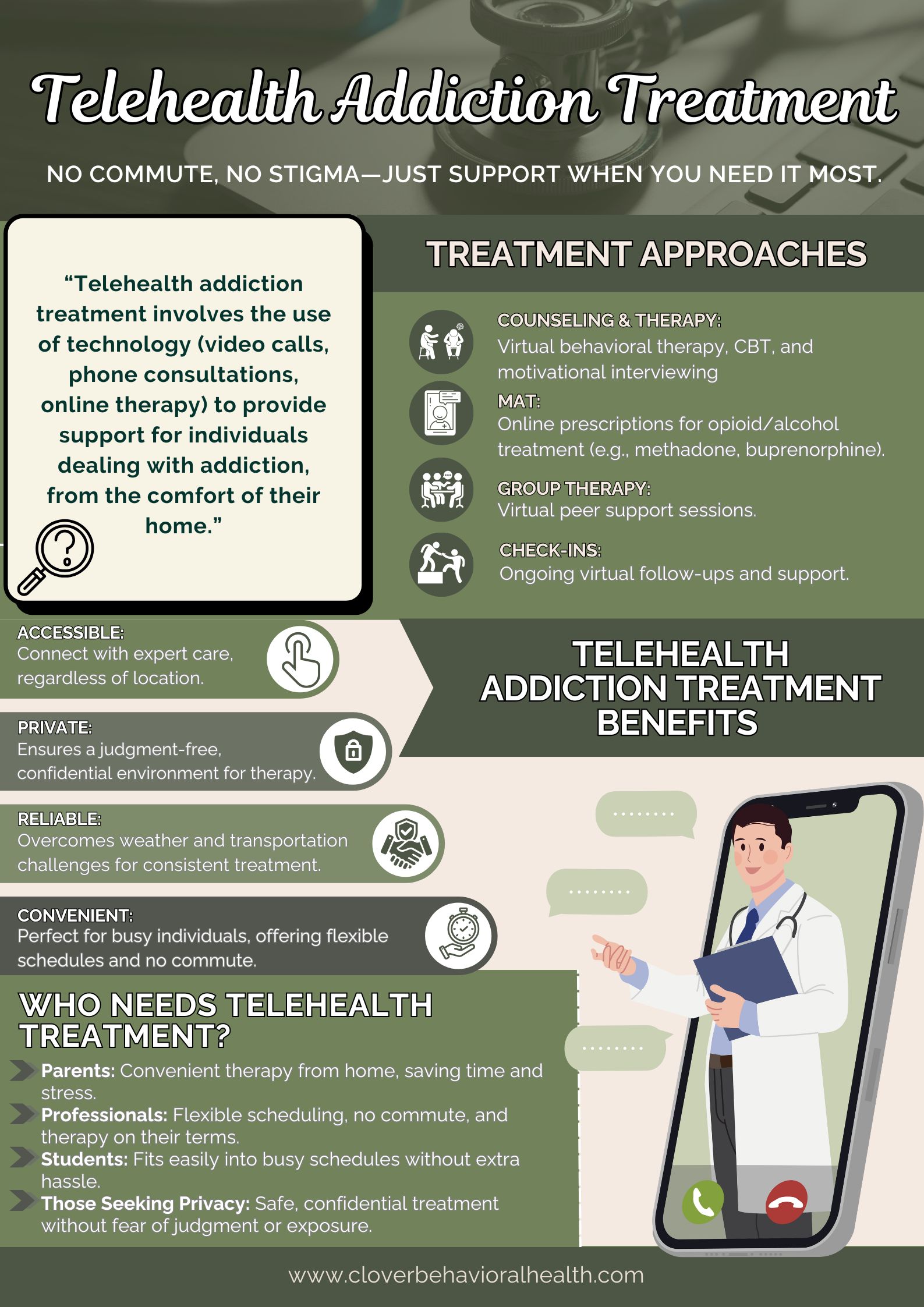
Accessible and Private Care From Home
For many individuals, the deterrent is walking into a physical treatment centre. Not only because of fear of judgment, but also because of scheduling challenges or having to accept that they need help in person.
Telehealth addiction treatment in Littleton, MA, solves this problem by bringing recovery support directly into the comfort of your home.
With just a phone, tablet, or laptop, you can connect with licensed professionals in a space where you already feel safe. This privacy helps reduce stigma and makes it easier to take that all-important first step toward recovery.
Compassionate Professionals Who Understand The Hidden Struggles of Addiction
Addiction isn’t a straightforward thing. There is a hidden journey beyond the surface, which is very crucial to understand for one’s recovery.
With telehealth addiction treatment in Littleton, MA, individuals can get access to non-judgmental, compassionate professionals from around the world who understand this and allow individuals to feel seen, heard, and supported in ways that finally break down that illusion of isolation for them.
Comprehensive, Personalized Care
Recovery from addiction is never one-size-fits-all. Therefore, when you look for telehealth addiction treatment in Littleton, MA, from hospitals like Clover Health, you get a combination of multiple approaches to meet different needs.
- One-on-one counselling creates a safe space to explore personal struggles and triggers.
- Group support brings connection and community, reminding clients that they’re not alone in this battle.
- Medication-assisted treatment (MAT) helps stabilize the brain’s chemistry, reducing cravings and giving individuals the clarity needed to focus on healing.
Together, these services provide a holistic path forward, supporting both the physical and emotional aspects of recovery.
Finding Hope Again with Telehealth Addiction Treatment in Littleton, MA
Breaking free from addiction isn’t about willpower alone; it is also about having the proper support. With Clover Behavioral Health, you can expect exactly that. We offer telehealth addiction treatment in Littleton, MA, which allows individuals to recover in a safe space, surrounded by compassionate professionals who create individualized plans on the basis of evidence-based therapies.
Please know that while recovery may initially feel impossible, it is simply a phone call away. So pick that phone and call us at 978-216-7765 to start this journey today – from the comfort of your home.