

MSE Myths vs. Facts: Understanding Mental Health Evaluation in Acton, MA
You know that Greek myth about Medusa? How just looking at her would turn you to stone? Everyone was terrified of her based on stories they’d heard. Turns out she was just a woman who’d been cursed. The monster was the myth, not the reality.
The Mental Status Examination (MSE) has its own Medusa effect going on in Acton.
You’ve made the appointment. You are sitting in your car outside the office. And your brain is whirling with all the horror stories you have ever heard. What if they think I’m crazy? What if they lock me up?
There are more myths surrounding the Mental Status Examination than a conspiracy theory. And those myths are keeping people in car parks with hands on steering wheels searching for whether to walk in or to drive home.
Let’s kill the myths. Right now.
Myth #1: “They’re Judging Everything I Do”
You walk in wearing yesterday’s sweatpants. Your hair won’t cooperate. You fumble with your phone. And you’re convinced they’re writing, “This patient is a disaster.”
The Reality:
They’re observing. Not judging. There’s a difference.
Your clinician does not think that you are lazy when he or she notices your unwashed hair. They are reasoning: This individual could be having a problem with self-care. That’s depression showing up. The wrinkled shirt isn’t a character flaw. Instead, it’s information.
Your clinician has seen people at their absolute worst. Nobody’s keeping score of who has it together. If you were fine, you wouldn’t be here. They know that.
Myth #2: “If I Cry, I Look Weak”
People feel tears coming and immediately apologize. “Sorry, I’m fine.” As if crying in a mental health office is somehow against the rules.
The Reality:
Your clinician wants to see real emotions. That’s the whole point. When you talk about trauma and laugh, it is noteworthy. When you are discussing something devastating and you have no emotions, it is remarkably noticeable as well. Not wrong. Just information.
Crying isn’t weakness. Some of the strongest people cry because they’ve actually let themselves feel things instead of building walls. You know what concerns a clinician? Someone describing their life falling apart with a flat voice and dead eyes. That disconnect is the red flag.
So cry if you need to. You’re not failing anything.
Myth #3: “There Are Right Answers I Need to Know”
People rehearse on the drive over. They practice their symptom descriptions. They panic about contradicting themselves.
The Reality:
This isn’t a test. There’s no answer key.
Your brain is messy. Mental health doesn’t follow a script. Sometimes you’ll say something and immediately backtrack. “Actually, no, it’s more like…” That’s fine. That’s how humans talk.
Your symptoms might contradict each other. Exhausted but can’t sleep. Want company but also want total isolation. That is a classical description of anxiety and depression occurring together. The contradictions, the interruptions, the I know not how to say this? That’s not wrong. That is what it is like to be a human.
Myth #4: “If I Admit How Bad It Is, They’ll Hospitalize Me”
This is the big one. The fear that stops people from being honest about suicidal thoughts or how close to the edge they really are.
The Reality:
Hospitalization isn’t a punishment. And it’s not automatic.
Can you be honest about suicidal thoughts? Yes. Most people with depression have them. Thinking about death and actively planning to die are very different things.
Your clinician asks those hard questions to assess risk. Do you have a plan? Have you rehearsed it? What’s keeping you here? They’re not asking so they can lock you up. They’re asking so they know what level of support you need.
Most people who admit to suicidal thoughts don’t get hospitalized. They get a safety plan. Crisis numbers. More frequent check-ins. Medication adjustments. Hospitalization happens when someone is in immediate danger and there’s no other way to keep them safe. Last resort. Not the first response.
However, lying about how bad things are, going home, and something terrible happening? That’s the actual nightmare scenario. Your clinician would rather know the truth and work with you than have you minimize everything and end up in danger.
Myth #5: “My Records Will Haunt Me Forever”
People worry their words will end up in some permanent file that follows them. That insurance sees it. Employers. Future consequences.
The Reality:
Your mental health evaluation records are protected by HIPAA. They don’t show up on background checks. Insurance companies see diagnostic codes, not your actual words.
Your clinician isn’t building a case against you. They’re documenting care so they can track what’s working and what isn’t.
The bigger risk isn’t what’s in your chart. It’s leaving things untreated because you’re too scared to be honest.
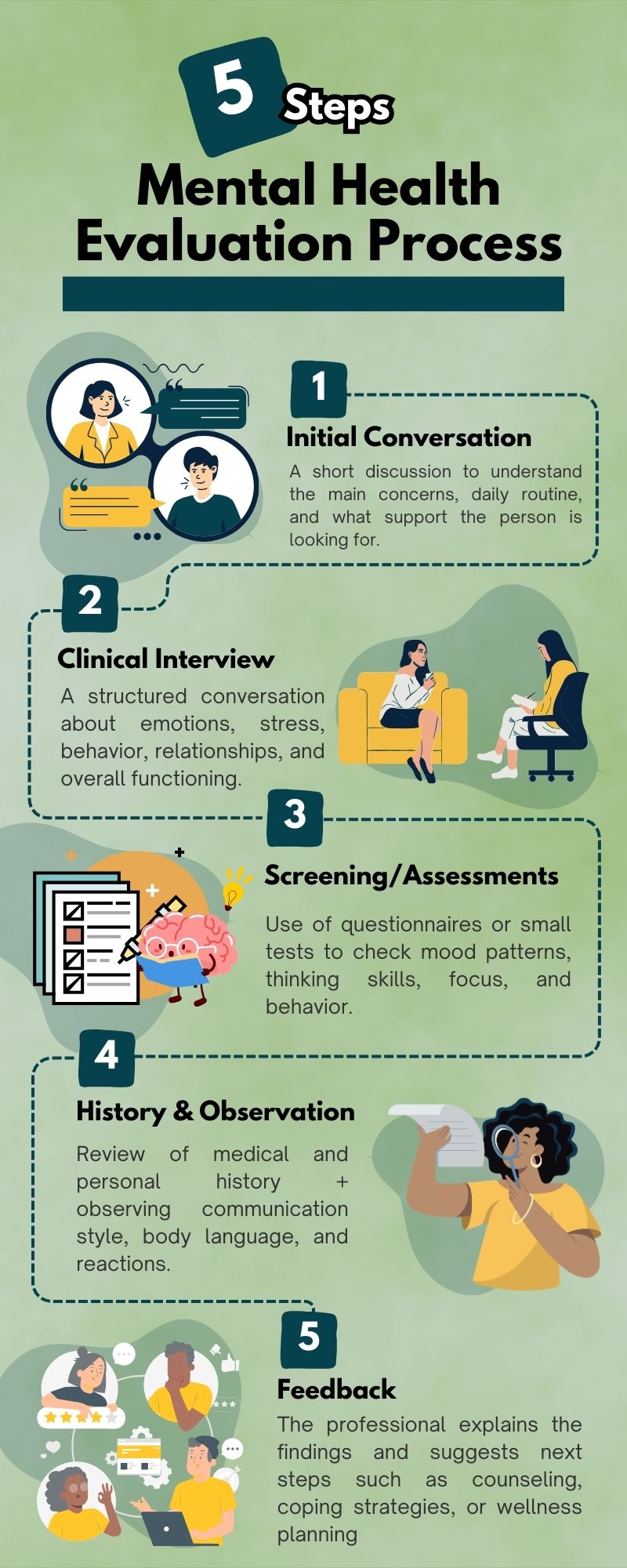
What the MSE Actually Is
If all those myths aren’t true, what is happening during an MSE?
Your clinician is noticing things. How you present yourself. Whether your mood matches what you’re saying. How your thoughts flow: organized, racing, slow, or scattered. Your speech patterns. Whether you can focus.
It all creates a snapshot. Not a judgment. A picture of where you are right now, so treatment can start there.
The Part That Should Actually Scare You
You want to know the real scary part? It’s not the MSE.
It’s the people who avoid it. Who convince themselves they’re fine when they’re drowning. Who tell themselves they’ll get help when it’s “bad enough,” not realizing they passed that point months ago.
The scary part is untreated mental illness. Not the evaluation that could help it.
Final Words
If you’re in Acton and thinking about getting evaluated, the myths are louder than the facts right now. Fear of the unknown always is.
The truth is that an MSE is a conversation with someone trained to help you make sense of what you’re experiencing. No gotcha questions. No traps. Just someone trying to understand so they can help.
At Clover Behavioral Health, they came in terrified and walked away knowing that it was nowhere as bad as they had thought.
The appointment you are shirking may be the one that transforms it all.
Call us at 978-216-7765. You don’t need everything figured out. You don’t have to perform wellness. Just show up as you are.
That’s exactly who we’re here to help.