

Depression Treatment Program in Massachusetts: Accommodating Outpatient Models
There is a common notion that if everything is okay in your life, your mental health should also be alright, which is untrue. Conditions like depression and anxiety don’t check your calendar, bank balance, or situation before they hit.
Talking specifically about depression, it can feel just as heavy for someone managing a corporate office as it does for a stay-at-home mom. And while its exhaustion is almost the same for everyone, how you fight it depends on your routine.
For example, a busy working professional might prefer a weekly session of a depression treatment program in Massachusetts, while someone else may prefer a few hours each day at the center and returning home at night.
That’s the reason different outpatient models of a depression treatment program in Massachusetts exist. This article explains different outpatient plans one can explore to heal and come out on the brighter side. Keep reading to know your options.
Different Models of a Depression Treatment Program in Massachusetts
Experts agree that a mental health treatment works well when it aligns with your life circumstances instead of isolating you or burdening you. When you can include healing in your routine, its effect lasts longer.
That said, here are some outpatient models of a depression treatment program in Massachusetts you can explore:
Partial Hospitalization (PHP)
Let’s start with the most demanding outpatient depression therapy in MA, a Partial Hospitalization Program. PHP is a high-level treatment also called day treatment meant for people struggling with severe depression who find it almost impossible to get through a normal day.
During this depression treatment program in Massachusetts, you go to a treatment center for five to seven hours a day, five days a week. Put simply, you receive professional care for depression for almost the entire day but get to return home every evening.
Naturally, its schedule is very structured. Your PHP day is filled with group therapy and one-on-one counseling to manage your meds. Since you are with professionals for most of the day, you have a massive safety net. That’s the reason doctors recommend this treatment for depression in MA, if someone is in a crisis or a deep rut that weekly therapy can’t fix.
PHP provides a level of care similar to an inpatient hospital stay, but you still get to stay in touch with home. If you are struggling to function at all, this program offers the highest chance of a real turnaround.
Intensive Outpatient (IOP)
IOP is another structured mental health treatment plan that provides several hours of therapy each week. It suits people needing more support than a standard one-hour therapy session, but not 24-hour supervision.
If you start this depression treatment program in Massachusetts, be ready to commit 9-15 hours per week. These will mostly be three-hour sessions held 3-5 days a week, often in the mornings or evenings to accommodate work or school.
Given its part-time nature, this program mostly focuses on group therapy for emotional regulation and coping skills. However, you also receive individual counseling and medication management.
Being a middle ground, this depression treatment program in Massachusetts works best for individuals struggling with this condition, but who can still manage their basic responsibilities. Because of the consistent time commitment, it is much more successful at breaking the cycle of depressive thoughts than once-a-week therapy.
Virtual Intensive Outpatient
Virtual IOP gives you the exact same expert care as the standard intensive outpatient, but digitally. This digital version of an IOP is for people who need more than a weekly therapy session but cannot commute to a treatment center due to a valid reason.
During this program, you join secure video sessions for about 9-15 hours a week: breaking it down, you attend virtual sessions three hours a day, three to five days a week. Just like the standard IOP, this one includes group therapy, counseling, and meetings with doctors to manage your medications.
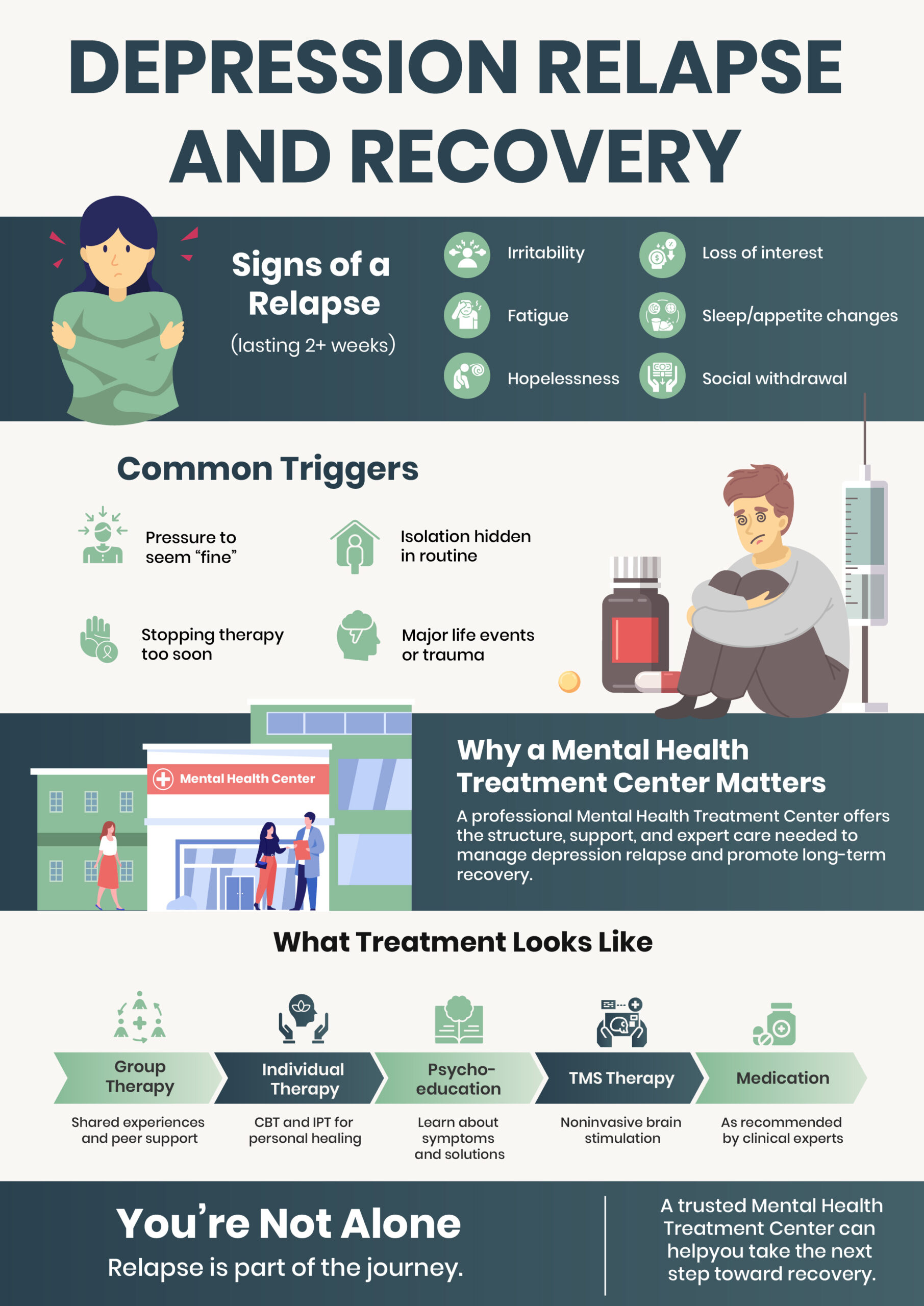
Since this type of depression therapy in MA removes hurdles like traffic or the anxiety of a waiting room, it’s a better choice for avoidant or antisocial people. So if you have a stable home life but need a strong professional push to break a depressive cycle, this one will work in your favor.
Standard Outpatient Therapy
Standard outpatient therapy is a basic form of mental health care where you meet with a therapist. It is the most flexible option, where you typically meet with the therapist for 45 to 60 minutes once a week or every other week.
This model is built for people who can still manage their daily jobs and chores but need professional help to handle their low moods or negative thoughts. When your symptoms are mild after another treatment, or you are in a stable place and just need maintenance support, experts prefer this standard model.
Because it only involves one hour a week, it is the least effective option for someone in a deep crisis. Needless to say, it lacks the daily structure or group support found in more intense programs. While its main benefit is that it fits easily into your life without any major changes to your routine, it does require you to do most of the heavy lifting between sessions.
Things Can Be Worked Out
Depression can take the color and light out of your life, but it can be fixed. If you’re committed enough and have experts’ help, you can lead a life where you’re the one controlling your thoughts, not the other way around.
If you’re ready to turn things around for the better and wish to break old patterns, call Clover Behavioral Health at 978-216-7765, and let’s make this happen. Our compassionate team and proven treatments make a brighter life possible for anyone, no matter how deep their depression has grown.