

Family Support During Mental Health Treatment in NH
Rei Kiriyama spends the first stretch of March Comes in Like a Lion eating dinner alone, sleeping in a bare apartment, and treating isolation like a survival strategy. The Kawamoto sisters don’t fix him. They don’t diagnose him or stage an intervention. They just keep setting a bowl of food in front of him and leaving the door unlocked, week after week, until showing up becomes the thing that eventually lets him put himself back together.
Family support during mental health treatment is rarely a single dramatic conversation that turns everything around. It is the accumulation of small, repeated acts of presence that make recovery survivable on the days when the person in treatment cannot yet do that work for themselves.
If a loved one is entering treatment in New Hampshire, it’s good to know that your role is not peripheral to the process. You’re often written directly into the treatment plan. Today’s blog is on what that involvement looks like, the therapy models behind it, and how it plays out inside NH’s treatment system specifically.
Why Family Involvement Matters in Treatment
Mental health conditions rarely develop or resolve in isolation. They take shape inside relationships. The way conflict gets handled at the dinner table. The unspoken rules about which feelings are allowed to be voiced. The roles each person quietly settles into over years of living together. Therefore, most modern treatment models treat the household as part of the clinical picture, not just the backdrop to it.
You’re Already Part of the System
Family therapists use the term “family system” because it describes something individual therapy alone can miss: a change in one person’s coping style inevitably changes how everyone around them responds, and vice versa.
If your loved one returns home from a group session with a new name for their anxiety, but the household still responds to any mention of anxiety with a shrug or minimization, that new skill has nowhere to go. The environment either enhances treatment gains or passively erodes them. Family therapy mostly exists to make sure it’s doing the former.
Family Involvement Predicts If The Treatment Works
Programs that build structured family sessions into the schedule report meaningfully higher completion rates and lower early dropout compared to programs that treat the patient as an isolated unit.
Accountability also plays a part in this. Those who know their family is tracking their progress, attending sessions, and adjusting their own behavior at home are less likely to quietly disengage when treatment gets uncomfortable around week three or four.
It Also Asks Something of You
Family therapy isn’t a briefing where a clinician explains your loved one’s diagnosis and sends you home with a pamphlet.
You’ll likely be asked to look at your own communication habits, your own instinct to either over-manage or avoid the situation entirely, and to change specific behaviors because your patterns are part of the environment your loved one is trying to heal inside of.
Four Approaches Therapists Use With Families
You may hear these terms during intake, a family session, or a discharge planning meeting in an NH program, and it helps to know roughly what each one actually does in the room.
1. Structural Family Therapy
Structural therapists focus on the structure of a family, who is making the decisions, and where the lines between generations or roles have become blurred.
For example, a teen who is an emotional confidant for a parent, or an older sibling who’s a second parent. The therapist might literally map out who is speaking to whom in session, who is left out of the conversation, and where the chain of command has quietly reversed.
The idea is to redraw those lines so that authority, information, and responsibility are where they should be for the real role each person has in the family.
2. Strategic Family Therapy
Strategic therapy skips the long historical dig and goes right to one specific, repetitive pattern of problems. Every time you talk about medication compliance, there’s a fight. Every time a parent asks about progress in treatment, there’s a shutdown.
The therapist creates a particular intervention to disrupt that exact cycle. Typically, there is very specific homework between sessions (“next time this topic comes up, try saying X instead of Y”). It’s more of a symptom-driven, shorter-term model that makes sense given the accelerated timelines of IOP and PHP programs.
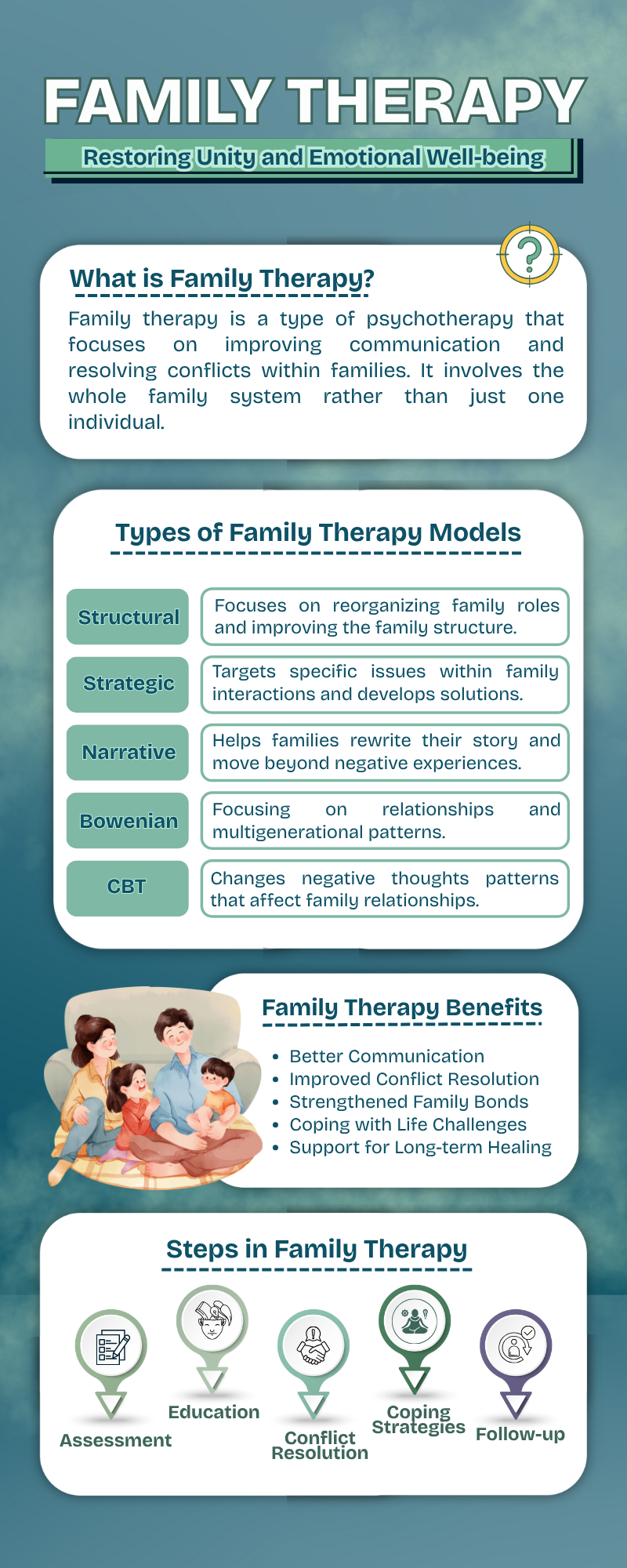
3. Bowenian Family Therapy
Bowenian work is long-range, looking at patterns handed down through the generations. The key idea here is “differentiation of self”: learning to stay emotionally connected to your family without losing your own sense of identity in someone else’s crisis.
This often translates to genogram work in practice, where clients chart the family tree through the generations to see where a pattern really started.
4. Systemic Family Therapy
Systemic therapy moves away from the family as a chain of cause and effect and toward the family as a closed loop, where each person’s reaction feeds back to the others’ behavior. Instead of asking who started a quarrel, a systemic therapist will ask how each person’s response sustains the circle.
The way a parent’s anxiety causes a child to withdraw, which causes the other parent to become frustrated, which feeds back into the first parent’s anxiety. It’s not linear; it’s circular, so a change to any one link in that loop (even a small one) can change the pattern for the whole group.
How Clover Behavioral Health Supports Families
At Clover Behavioral Health, family involvement is written into the treatment plan from intake rather than added on as an afterthought partway through. Family sessions are scheduled alongside individual and group therapy. Moreover, the team keeps families informed at the milestones that truly matter for planning ahead, not just when something goes wrong.
If a clinician uses a term like “differentiation” or “enmeshment” during a session, expect them to properly explain what that means for your specific household and what it would look like to practice differently, rather than leaving you to piece it together from a handout after the fact.
Final Words
We don’t anticipate that you will come in knowing your structural boundaries or Bowenian genograms. Instead, progress is driven by something closer to what the Kawamoto household does for Rei. Showing up on days when it would be easier not to, being willing to look honestly at your own patterns even when that’s uncomfortable, and trusting the clinical team to handle the parts that require training you don’t have. Ultimately, family therapy requires consistency from you, not expertise.