

321 Billerica Road, Suite 206 Chelmsford MA 01824

7 Stiles Rd. Suite 101, Salem, NH 03079

How Long Does IOP Last in New Hampshire?

How Long Does IOP Last in New Hampshire? How Long Does IOP Last in New Hampshire? Outpatient Timeline

How Long Does IOP Last in New Hampshire? Outpatient Timeline

People often ask this when life is already crowded. Work is piling up, family needs attention, and treatment can feel like one more unknown. 

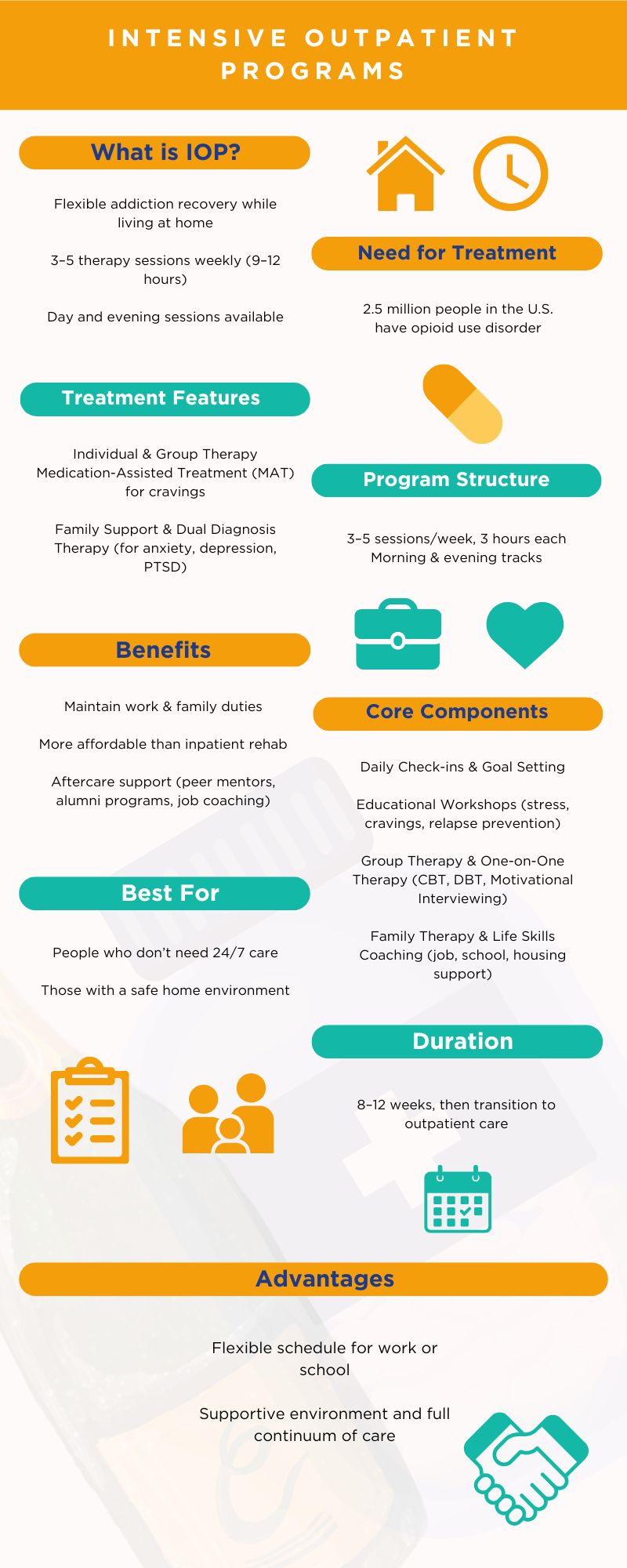
The good news is that an Intensive Outpatient Program in New Hampshire usually lasts about 8 to 12 weeks, though the timeline can change based on clinical needs, progress, and attendance. 

At Clover Behavioral Health, we offer Intensive Outpatient Services and broader outpatient support through our Salem location, and we build care around the person, not around a rigid cookie-cutter calendar.

What Determines the Duration of a New Hampshire IOP?

The length of an IOP usually depends on clinical progress, not just the calendar. A person’s treatment plan, mental health needs, substance use history, home environment, and response to therapy all shape how long care lasts.

That matters because recovery is rarely a straight line. One person may stabilize faster and step down sooner. Another may need a longer runway. And honestly, that is normal. The federal treatment guidance on intensive outpatient care says duration should increase or decrease based on clinical needs, support systems, and psychiatric status.

At Clover Behavioral Health, treatment starts with a thorough evaluation that looks at your needs, challenges, and goals before a customized plan is built. In other words, your timeline is based on how you are actually doing, not on some number pulled out of thin air.

Factors That Can Affect Your Personal IOP Timeline

  • Presence of anxiety, depression, or other co-occurring mental health symptoms.
  • Stability of your home environment and support system.
  • Severity and duration of substance use.
  • Consistency in attendance and participation.
  • Progress with coping skills, relapse prevention, and daily functioning.
  • Whether you are stepping down from a higher level of care or stepping up from standard outpatient treatment.

How Many Hours Per Week Does Outpatient Therapy Require?

A standard IOP usually requires 9 or more hours of treatment per week, often spread across 3 to 5 days. Federal clinical guidance notes that many programs provide structured services for 9 hours or more weekly, and Clover’s own intensive outpatient page describes a structured but flexible half-day model built around daily responsibilities.

This is where IOP becomes practical. It gives you meaningful treatment time without asking you to move out, hit pause on your life, or disappear from your home routine. That middle ground is why so many people find it workable. Think of it as a strong bridge between full-day treatment and basic weekly counseling.

At Clover, our intensive outpatient treatment model includes individual therapy, group therapy, family therapy, educational workshops, and regular monitoring and support. That structure is not there to overwhelm you. It is there to keep treatment steady enough to matter.

Treatment Phase

Weekly Hourly Commitment

Typical Duration

Intensive Stabilization

12 to 15 hours per week. 

Weeks 1 to 4. 

Transition Phase

9 to 12 hours per week. 

Weeks 5 to 8. 

Step-Down Support

3 to 6 hours per week, or transition to standard outpatient care. 

Weeks 9 to 12 and beyond. 

These numbers can shift. Some people need more time upfront. Others taper faster. Still, the general shape stays the same: more support early, more independence later. That is the point.

The Typical 12-Week Intensive Outpatient Timeline Breakdown

Most people want a roadmap. Not because they expect recovery to be neat, but because knowing what comes next makes treatment feel less intimidating. A rough 12-week timeline helps people picture how care unfolds in real life.

Federal outpatient guidance describes intensive outpatient treatment as a step within a continuum of care, with treatment often delivered in stages and intensity tapering as clients progress. That staged approach is a big reason IOP works. It gives people time to build traction before they are asked to carry more of the load on their own.

  1. Weeks 1 To 4: Intensive Skill Building: This is usually the busiest phase. Clients often attend the highest number of weekly hours while learning how to spot triggers, manage cravings, and handle emotional stress without falling back into old patterns. It is the “steady the ship” phase.
  2. Weeks 5 To 8: Real-World Application: By now, treatment starts stretching into daily life. Clients may reduce clinical hours a bit while practicing coping strategies at work, at home, or in social settings. This is where theory meets reality, and that can be messy sometimes. Still, it is where confidence grows.
  3. Weeks 9 To 12: Discharge And Aftercare Planning: Toward the end, the focus shifts to long-term stability. Clients work on relapse prevention plans, community support, family communication, and a safe next step after IOP. That may include our outpatient rehab program or another lower-intensity support track.
IOP for addiction iop for mental health

➡️ If you are also weighing care intensity, read our latest blog, “IOP vs PHP in Salem, NH: Which Program Is Right for You?” for a clearer side-by-side look at both treatment paths. 

Clinical Modalities Practiced Throughout the Program

Strong programs do more than fill time. They teach skills people can actually use on a bad Tuesday, in a stressful meeting, or during a lonely evening when the old urges come knocking.

At Clover Behavioral Health, our treatment model includes evidence-based therapies and whole-person support. Our site highlights Cognitive Behavioral TherapyDialectical Behavior Therapy, family therapy, holistic therapies, and educational support as part of care.

  • Cognitive Behavioral Therapy (CBT): Helps break automatic thought patterns that can trigger cravings, shame, or all-or-nothing thinking.
  • Dialectical Behavior Therapy (DBT): Builds emotional regulation, distress tolerance, and mindfulness skills for rough moments.
  • Relapse Prevention Mapping: Creates a written plan for warning signs, emergency contacts, and next-step actions when risk rises.
  • Dual-Diagnosis Support: Our dual-diagnosis treatment programs help address mental health and substance use together, because those issues often travel as a pair.

Clinical Timeline Study

real study from a New England hospital followed 113 adults in an alcohol-focused partial hospitalization program, a structured outpatient level of care that often serves as a step before lower-intensity treatment. Patients attended treatment on weekdays from 9:00 a.m. to 3:30 p.m., with group therapy, individual counseling, and medication support. 

Their average stay was just over 7 days, and when researchers checked back one month later, 69.7% were still abstinent. The study also found that people who kept up with mental health visits and 12-step meetings after discharge had better short-term outcomes. That is the big takeaway: structured care works better when aftercare stays in place. 

Establish Your Recovery Foundation Close to Home

Eight to twelve weeks may sound like a long stretch when you are standing at the starting line. But compared with the cost of staying stuck, it is often a small window that can change a lot. 

At Clover Behavioral Health, we offer structured, flexible care through our Salem location, including Intensive Outpatient Services, day treatment, and ongoing outpatient support.

Contact our team today to verify insurance, talk through morning or evening scheduling options, and book a confidential clinical evaluation. Sometimes the first clear timeline is what makes the first real step possible.

Medically Reviewed By:

Jennifer Mclean LMHC

Outpatient Rehab Near Lawrence, MA The Rehab Option Most Working Adults Wish They Knew About Sooner
Outpatient Addiction Treatment
Clover Behavioral Health

Outpatient Rehab Near Lawrence, MA

If you don’t want to choose between recovery and responsibility, outpatient rehab near Lawrence, MA, will suit you best. Let’s learn how it works and how it can help you.

Read More »
Therapy and IOP Near Londonderry, NH What Happens During Therapy and IOP? A Look Inside the Process
Intensive Outpatient Program
Clover Behavioral Health

Therapy and IOP Near Londonderry, NH

Therapy and IOP near Londonderry, NH, for mental health and addiction are always accessible. Let’s list a few ways you can benefit from these models for your better future.

Read More »
verify insurance now

Get Personalized Help Now

Let Us Call You!

Confidential Assessment

Provide your best contact number and our treatment team will reach out to you!